Marietta was recognized as a town on Dec. 19, 1834, and incorporated in 1852. Its National Register listings, museums and historic cemeteries, with hours.
Last checked Oct. 5, 2026. History comes from the City of Marietta’s Marietta History page, written by the Marietta Museum of History. National Register listings come from the National Park Service’s National Register database (May 22, 2026 file). Hours come from each museum’s own site.
Marietta is older than Atlanta. The city’s history page says a small cluster of homes near the Cherokee town of Kennesaw was reported as early as 1824, and the town grew into a railroad base, a Civil War crossroads and the county seat of Cobb County.
Who to call
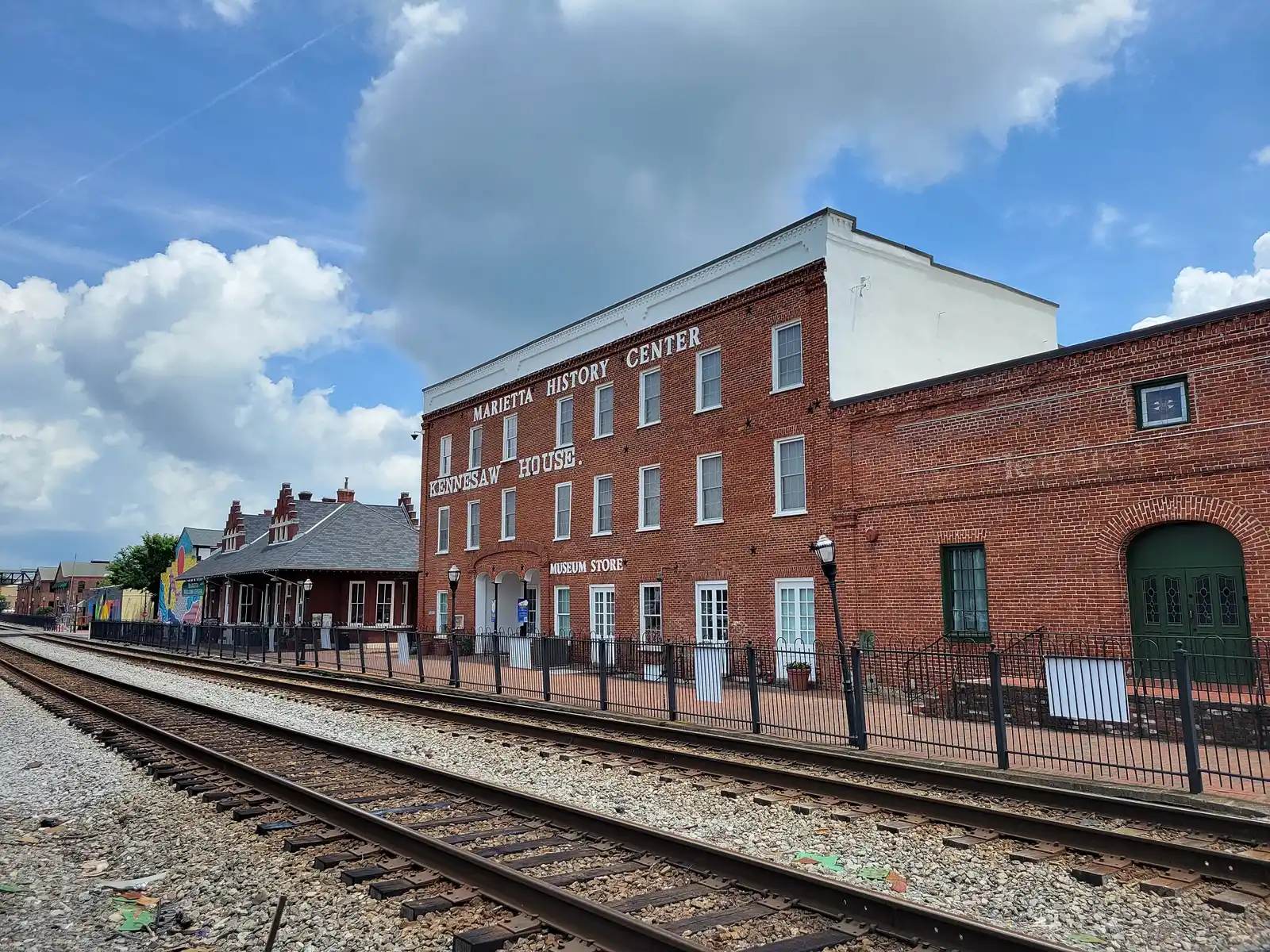
- Marietta History Center: 1 Depot St. NE, in the Kennesaw House; hours and admission
- Gone With the Wind Museum at Brumby Hall: 472 Powder Springs St.; museum site
- Historic districts and landmarks: City of Marietta Planning and Zoning, 770-794-5669; historic preservation page
- City cemeteries: Marietta Parks and Recreation, 770-794-5601
How Marietta began
From the city’s history page:
- 1824: Homes near the Cherokee town of Kennesaw are reported.
- 1832: Georgia forms 10 counties from Cherokee land. Cobb County is named for Thomas Willis Cobb, U.S. representative, U.S. senator and judge.
- 1833: James Anderson lays out the first plat of the town, with a square and a modest courthouse at its center.
- Dec. 19, 1834: The Georgia legislature legally recognizes the town.
- 1837: The Georgia Gazetteer reports that Marietta was named for Cobb’s wife.
- Late 1830s to 1850: The state creates the Western and Atlantic Railroad. Its engineer, Col. Stephen Long, makes Marietta his base, and business booms around the Square. Trains run from Atlanta to Adairsville by 1845 and through to Chattanooga by 1850.
- 1851: The Georgia Military Institute opens about a mile from the Square on Powder Springs Road.
- 1852: Marietta incorporates, and John Glover is elected its first mayor.
- 1850s: Fire destroys much of the town three times. The city’s Fire Museum page says the Marietta Fire Department was formed in 1854 after a fire destroyed most of the Square.
The Civil War
In April 1862, the Union raiders led by James Andrews spent the night in Marietta’s Fletcher House and Cole’s Marietta Hotel. The next morning they boarded a train at Marietta station and seized it a few minutes later at Big Shanty, beginning what is known as the Great Locomotive Chase. The Marietta History Center shows the room in the Kennesaw House where the raiders finalized their plans.
In the summer of 1864, forces under William Tecumseh Sherman occupied the town. In November 1864, troops under Union Gen. Hugh Kilpatrick set it on fire as Sherman’s army left for the March to the Sea.
National Register of Historic Places
The National Park Service’s database lists these properties with a Marietta address, with the year each was listed. Several are outside the city limits.
Historic districts in the city
| Listing | Listed |
|---|---|
| Northwest Marietta Historic District, along Kennesaw Avenue and Whitlock Avenue | 1975 |
| Church Street-Cherokee Street Historic District | 1985 |
| Washington Avenue Historic District | 1989 |
| Whitlock Avenue Historic District | 1989 |
| Atlanta-Frasier Street Historic District | 1995 |
The city’s nomination forms for all five are on its National Register districts page.
Buildings and sites
| Listing | Address | Listed |
|---|---|---|
| Arnoldus Brumby House (Brumby Hall) | 472 Powder Springs St. | 1977 |
| Glover-McLeod-Garrison House | 250 Garrison Road SE | 1977 |
| Braswell-Carnes House | 2430 Burnt Hickory Road NW | 1984 |
| Zion Baptist Church | 149 Haynes St. | 1990 |
| Frobel-Knight-Borders House | 1001 Allgood Road | 1995 |
| Marietta National Cemetery | 500 Washington Ave. | 1998 |
| William and Hannah Root House | 145 Denmead St. NW | 2014 |
| Smith-Manning House | 360 Manning Road | 2014 |
| Lemon Street School | 350 Lemon St. | 2024 |
Nearby, with a Marietta address: Kennesaw Mountain National Battlefield Park (1966), Sope Creek Ruins (1973), Gilgal Church Battle Site (1975), the William Gibbs McAdoo House (1978), the Andrew J. Cheney House (1979), the J.C. Bankston Rock House on Dobbins Air Reserve Base (1994), the George A. Power House (2001) and the Power-Hyde Farm Historic District (2024).
The city also protects four local landmarks: Brumby Hall, the Clarke Library, the Marietta Water Works and the Smith-Manning House, according to its local landmarks page.
Museums
The city promotes “six museums, one square”:
| Museum | Where | Hours |
|---|---|---|
| Marietta History Center | Kennesaw House, 1 Depot St. NE | Tuesday to Saturday, 10 a.m. to 4 p.m.; free on the third Saturday of the month |
| Marietta Gone With the Wind Museum | Brumby Hall, 472 Powder Springs St. | Tuesday to Saturday, 10 a.m. to 4 p.m.; closed city holidays |
| Marietta Fire Museum | See the city’s page | Check before you go |
| William Root House | 80 N. Marietta Parkway NW | Tours and events listed on Visit Marietta |
| Marietta Cobb Museum of Art | 30 Atlanta St. SE | Check the museum’s site |
| Old Zion Church Heritage Museum | See the city’s museums page | Check before you go |
The History Center is closed on the Fourth of July, Thanksgiving and the day after, Christmas Eve, Christmas Day and New Year’s Day. The Fire Museum displays the “Aurora,” an 1879 Silsby horse-drawn steamer the city says is one of only five still in existence, and a 1921 American LaFrance pumper.
Historic cemeteries
- Marietta National Cemetery, 500 Washington Ave. Henry Greene Cole, a Unionist innkeeper, offered the land. More than 17,000 men are buried there, more than 3,000 of them unknown, the city says.
- Marietta Confederate Cemetery, 381 Powder Springs St. Established in 1863; more than 3,000 Confederate soldiers were reburied there after the war, according to the city’s page.
- Marietta City Cemetery, 420 W. Atlanta Road. Established in the 1830s, it holds a broad cross section of the town’s early residents. The city’s grave-site mapping application helps find a grave.
What this means for you
- Start at the History Center on a third Saturday, when admission is free.
- Walking the historic districts? The nomination forms on the city’s site describe each house.
- Planning work on a historic house? Check with Planning and Zoning first.
Related guides: parks and trails, things to do this month and getting around.
Frequently asked questions
When was Marietta, Georgia, founded?
The Georgia legislature legally recognized the town on Dec. 19, 1834; its first plat was laid out in 1833. Marietta incorporated as a city in 1852, when John Glover was elected its first mayor, according to the city’s history page.
Who is Marietta, Georgia, named after?
The 1837 Georgia Gazetteer reported that Marietta was named for the wife of Thomas Willis Cobb, the U.S. representative, senator and judge for whom Cobb County is named.
What happened in Marietta during the Civil War?
In April 1862 the Union raiders behind the Great Locomotive Chase stayed in Marietta’s hotels before seizing a train at Big Shanty. Federal troops occupied the town in summer 1864 and set it on fire in November 1864.
What are the museums in Marietta?
They include the Marietta History Center in the Kennesaw House, the Gone With the Wind Museum at Brumby Hall, the Marietta Fire Museum, the William Root House, the Marietta Cobb Museum of Art and the Old Zion Church Heritage Museum.
When is the Marietta History Center open?
Tuesday through Saturday, 10 a.m. to 4 p.m.; closed Sundays, Mondays and major holidays. Admission is free on the third Saturday of each month.
Have your say